Navigating the Visa Maze: Your Guide to Long-Term Stays in Bali
Planning a long stay in Bali? Learn VOA vs 60-day visas, extensions, multi-entry rules, ITAS and Second Home, plus overstay tips with fees and timelines.

Indonesia’s immigration policies continuously adapt to balance tourism with regulatory oversight. A short-term visit can easily evolve into a semi-permanent lifestyle, but confusing a residence permit with a work permit or miscalculating overstay dates can lead to severe penalties, including fines of IDR 1,000,000 per day, deportation, and blacklisting. All fee structures and regulatory details in this guide reflect official Directorate General of Immigration parameters via evisa.imigrasi.go.id
1. Define Your Real Stay Profile
Before applying, match your travel intentions to the correct legal category. Mismatched application types are the leading cause of processing delays and border complications.
Profile
Target Duration
Typical Visa Pathway
Primary Purpose
Testing the Waters
30 to 60 Days
VOA / e-VOA
Tourism, short exploration, brief family visits.
Seasonal Resident
2 to 6 Months
Extendable Visit Visa (C1)
Continuous extended stay, wellness retreats, slow travel.
Regional Nomad
Up to 1–5 Years
Multiple-Entry Visit Visa (D1/D2)
Frequent entry/exit with cap on consecutive days per visit.
Overseas Remote Worker
1 Year (Renewable)
Remote Worker KITAS (E33G)
Living in Bali while employed strictly by foreign entities.
Long-Term Relocation
5 to 10 Years
Second Home Visa / ITAS
High-net-worth residency, family ties, or formal retirement.
2. Overview of Primary Visa Categories
Visa on Arrival (VOA) & e-VOA

Best for short exploratory trips with a single optional extension.
-
Initial Validity: 30 days.
-
Extension: One-time 30-day extension (Max 60 days total).
-
Official Fee: IDR 500,000 base government charge.
-
Permitted Activities: Pure tourism, visiting family/friends, transit, attending meetings/exhibitions.
Single-Entry Visit Visa (Category C1)
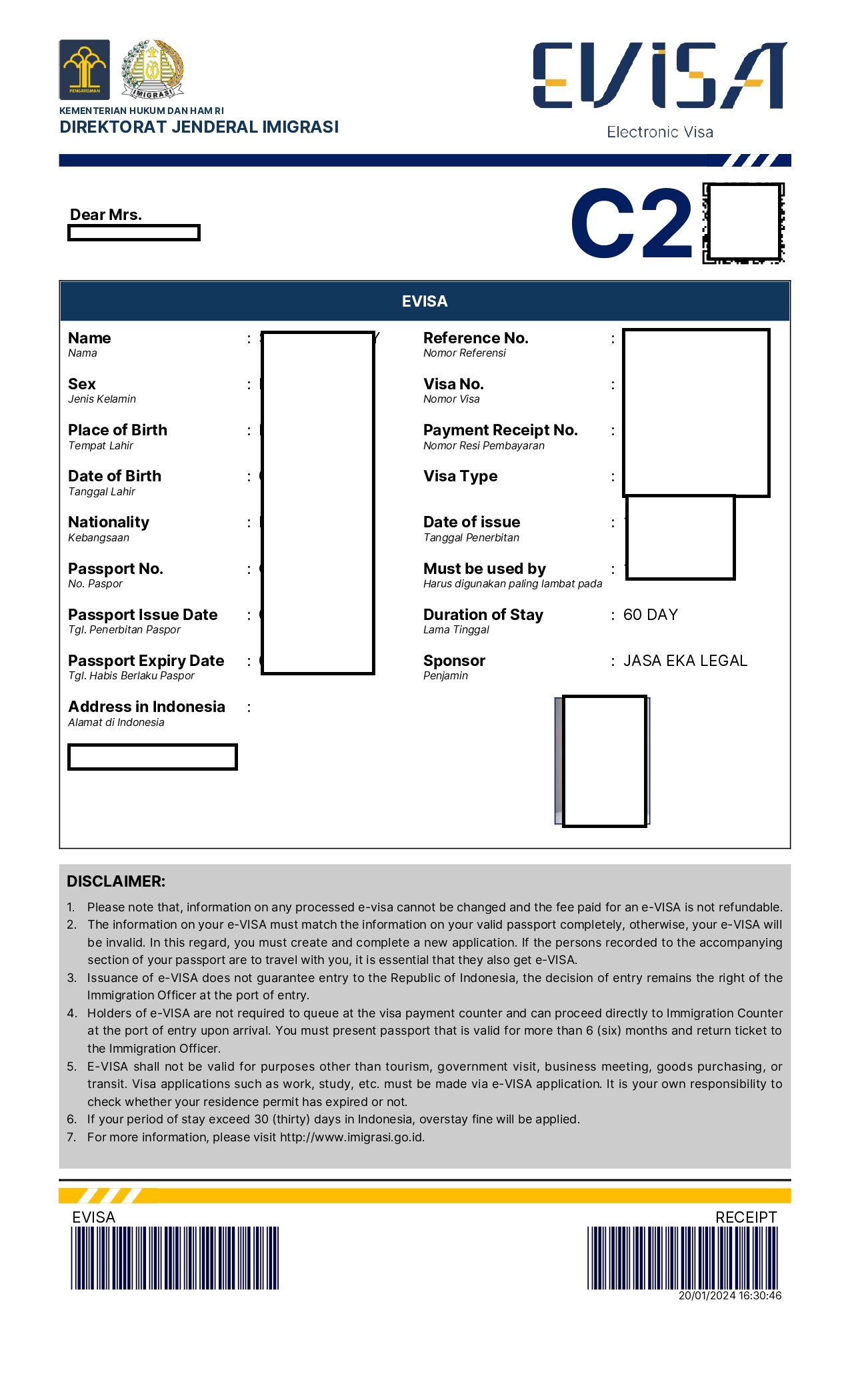
The gold standard for a multi-month continuous stay without leaving Indonesia.
-
Initial Validity: 60 days.
-
Extensions: Extendable up to two times for additional 60-day blocks (reaching up to 180 days total).
-
Official Base Fee: IDR 1,500,000 – IDR 2,000,000.
-
Processing Standard: Typically 5 to 7 working days upon submitting complete documentation.
Multiple-Entry Visit Visa (Category D1 / D2)
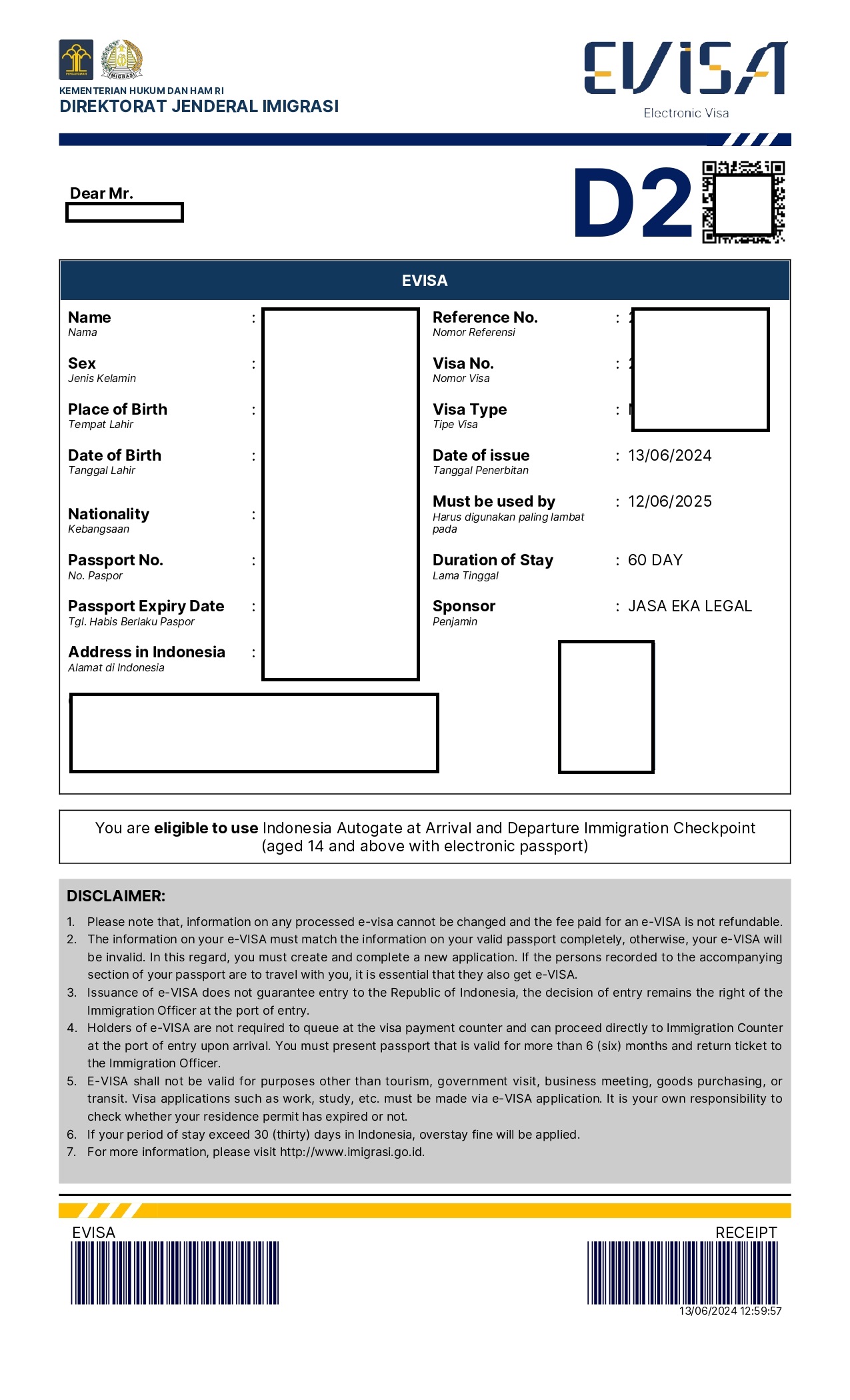
Designed for regional travelers using Bali as a home base.
-
Validity Options: 1, 2, or 5 years.
-
Stay Cap: Maximum 60 or 180 days per entry (depending on the specific tier issued).
-
Crucial Reality Check: This is not a continuous residence permit. You are legally required to exit the country before reaching your per-entry day limit.
Remote Worker KITAS (E33G)

The official legal pathway for digital nomads and foreign remote employees.
-
Validity: 1 Year (Extendable).
-
Primary Condition: Must show proof of employment with an entity established outside Indonesia and an annual income threshold of at least USD $60,000.
-
Critical Distinction: The E33G is a residence permit, not a local work permit. Earning income from Indonesian businesses or clients on this visa remains strictly prohibited.
Second Home Visa & Residency ITAS/KITAS
For long-term residence, investment, or family integration.
-
Validity: 5 to 10 Years.
-
Primary Requirement: Proof of financial sufficiency (e.g., dedicated bank balance holding at least IDR 2 Billion or equivalent luxury real estate rights).
Important Legal Context: Holding a Second Home Visa or KITAS does not automatically grant outright freehold ownership of land. Property rights for foreign nationals in Indonesia operate under distinct legal frameworks (such as Hak Pakai / Right to Use or Leasehold) regardless of your visa status.
3. Deep Dive: C1 Single-Entry Tourist Visa
For travelers seeking a 2 to 6-month uninterrupted stay, the C1 Single-Entry Visitor Visa (formerly known as the B211A Tourist Visa) is the primary pathway.
Key Parameters of the C1 Visa
The C1 Single-Entry Tourist Visa offers an initial stay duration of 60 days, with the countdown starting on the exact day you arrive in Indonesia (Day 1). Once issued, the visa comes with a 90-day validity window, meaning you must use it to enter the country within that timeframe, or it will expire unused.
For travelers planning a longer trip, this visa can be extended up to two times. Each 60-day extension allows for a cumulative stay of up to 180 days without needing to leave the country. However, because it is strictly a single-entry visa, departing Indonesia at any point immediately voids it, regardless of how many permitted days you have left.
The base government fee for the C1 visa ranges between IDR 1,500,000 and IDR 2,000,000, depending on the specific application path and service tier selected. Payment is conveniently submitted online via Mastercard, Visa, or JCB credit and debit cards.
4. C1 Document Preparation Checklist
Ensure all uploaded files meet mandatory format and clarity standards to avoid administrative delays.
-
Valid Passport (Biometric Page):
-
Full, clear color scan (JPEG/PNG format, no cropped corners).
-
Must have at least 6 months of validity remaining from the date of arrival in Indonesia.
-
Must contain at least two blank pages for entry/exit stamps.
-
-
Recent Digital Color Photograph:
-
Passport-style headshot on a plain white or light background.
-
Neutral facial expression with full view of the face; soft lighting without reflections.
-
-
Proof of Financial Sufficiency:
-
Official bank statement covering the last 3 consecutive months.
-
Must show a minimum ending balance equivalent to USD $2,000.
-
The account holder's full legal name on the statement must strictly match the passport name.
-
-
Onward or Return Flight Details:
-
Confirmed flight booking showing exit from Indonesia within the initial 60-day window.
-
-
Accommodation Proof:
-
Valid booking confirmation (hotel, villa rental agreement, or guesthouse invoice) showing a specific residential address in Indonesia.
-
5. Step-by-Step C1 Application Process
-
Navigate to the official Directorate General of Immigration portal.
-
Click Apply -> Register.
-
Fill in personal details and upload a clean copy of your passport biodata page.
-
Confirm account registration via the automated email link within 60 minutes.
-
Log in to your verified account and select Apply Visa.
-
Choose Tourism / Visit as the main purpose, select Single Entry, and pick C1 Tourism.
-
Input intended arrival date, flight details, and local address in Indonesia (e.g., street name, district, province).
-
Upload your passport photo, full biodata scan, bank statement, and return ticket.
-
Verify that diacritics, middle names, and passport numbers match field entries character-for-character.
-
Pay the official fee using a 3D-Secure enabled international credit card (Visa, Mastercard, or JCB).
-
Save the transaction receipt (SIMPONI billing invoice) for reference.
-
Upon approval, a downloadable PDF of the electronic visa (e-Visa) will be sent to your registered email.
-
Download and print two physical copies to carry in your travel luggage, and save a digital backup to your mobile device.
6. On-Arrival & Non-Visa Entry Requirements
Upon arrival at an Indonesian Port of Entry (such as Ngurah Rai International Airport - DPS), present:
-
Physical Passport (valid for at least 6 months).
-
Printed C1 e-Visa PDF.
-
All Indonesia Arrival Card: A mandatory electronic health and customs declaration completed online within 72 hours prior to arrival via allindonesia.imigrasi.go.id.
-
Bali Foreign Tourist Levy: A provincial tax of IDR 150,000 per visitor, paid via the official Love Bali portal (lovebali.baliprov.go.id).
7. Extensions & Regulatory Enforcement
Managing C1 Onshore Extensions
-
Timing: Initiate your extension 10 to 14 days prior to your current 60-day period expiring.
-
Process: Log into your evisa.imigrasi.go.id account, select Extend under your active visa, and follow the prompts.
-
Biometrics: For certain extensions, a brief visit to the nearest local Immigration Office (Kantor Imigrasi) may be scheduled for facial photo scanning and digital fingerprinting.
⚠️ Compliance Warnings & Overstay Fines:
-
No Local Work: Holding a visit visa strictly forbids taking employment, invoicing local clients in IDR, or providing services to Indonesian entities.
-
Overstay Fines: Minor overstays trigger a mandatory administrative fine of IDR 1,000,000 per day.
-
Severe Penalties: Overstaying beyond 60 days results in formal detention, deportation at the traveler's expense, and entry blacklisting ranging from 6 months to several years.
There is no practical difference—C1 is the official updated classification for the former B211A Tourist Visa under Indonesia's modernized immigration system. While travelers and expat communities still commonly refer to it as "B211A," all official applications filed via evisa.imigrasi.go.id are now issued under the C1 Visitor Visa category.
Legally, the C1 visa prohibits local employment, selling products, or providing services to Indonesian clients/businesses. While digital nomads working quietly on laptop tasks for overseas employers exist in a legal gray area, doing work for local Indonesian entities or receiving payment into an Indonesian bank account is strictly illegal. For fully compliant remote work, apply for the Remote Worker KITAS (Category E33G).
Because the C1 is a Single-Entry Visa, leaving Indonesia (even for a short weekend trip to Singapore or Malaysia) immediately voids the visa. Once you clear airport immigration to depart, you cannot re-enter on the same visa and will need to apply for a new visa to return.
You should initiate your onshore extension 10 to 14 days before your current 60-day permit expires. Do not wait until the final week. Processing times can vary depending on system queue volumes and whether you are required to attend a local Immigration Office (Kantor Imigrasi) for biometrics (fingerprinting and digital photo).
Indonesian Immigration enforces overstay rules strictly: Short Overstays (Under 60 Days): A fine of IDR 1,000,000 per day. Long Overstays (Over 60 Days): Immediate detention, mandatory deportation at your own expense, and a formal entry blacklisting (prohibiting return to Indonesia for 6 months to several years).
Applications submitted directly by individual tourists on the official immigration portal (evisa.imigrasi.go.id) generally require personal documentation (such as proof of financial funds showing at least USD $2,000). However, applying through a registered Indonesian visa agency or guarantor can streamline the application and onshore extension processes.
No. The IDR 150,000 Bali Foreign Tourist Levy is a separate regional tax dedicated to cultural preservation and environmental infrastructure. It must be paid independently via the official Love Bali platform (lovebali.baliprov.go.id) prior to or upon arrival at Ngurah Rai Airport (DPS).
The best villas, before they're booked.
Join 12,000 travellers getting new stays & direct-booking deals monthly.
Ready to book your next escape?
Every villa here is managed and bookable directly through Villas R Us — meaning the best rate, a real human on WhatsApp, and staff who'll have your workspace and Wi-Fi sorted before you land.
Other Articles